
Democracy in Peril
Friends of Maldives Statement 14.3.2015
Following the blatant and grotesque injustice in the Maldives where former President Mohamed Nasheed, democracy and human rights campaigner, was sentenced to a 13 years prison sentence Friends of Maldives (FOM) call upon the International community to:
- Freeze the assets abroad of members of the Maldives Government and their leading supporters in the Maldivian business community
- Imposing a travel ban on members of the Government of Maldives and leading supporters in the Maldivian business community
- Impose an immediate arms embargo on the Maldives
- Immediate suspension from the Commonwealth
- The travel industry and the general public to consider a tourism boycott to the resorts owned by members of the Maldivian business community who are closely associated with the regime.
FOM Statement 22.2.2015
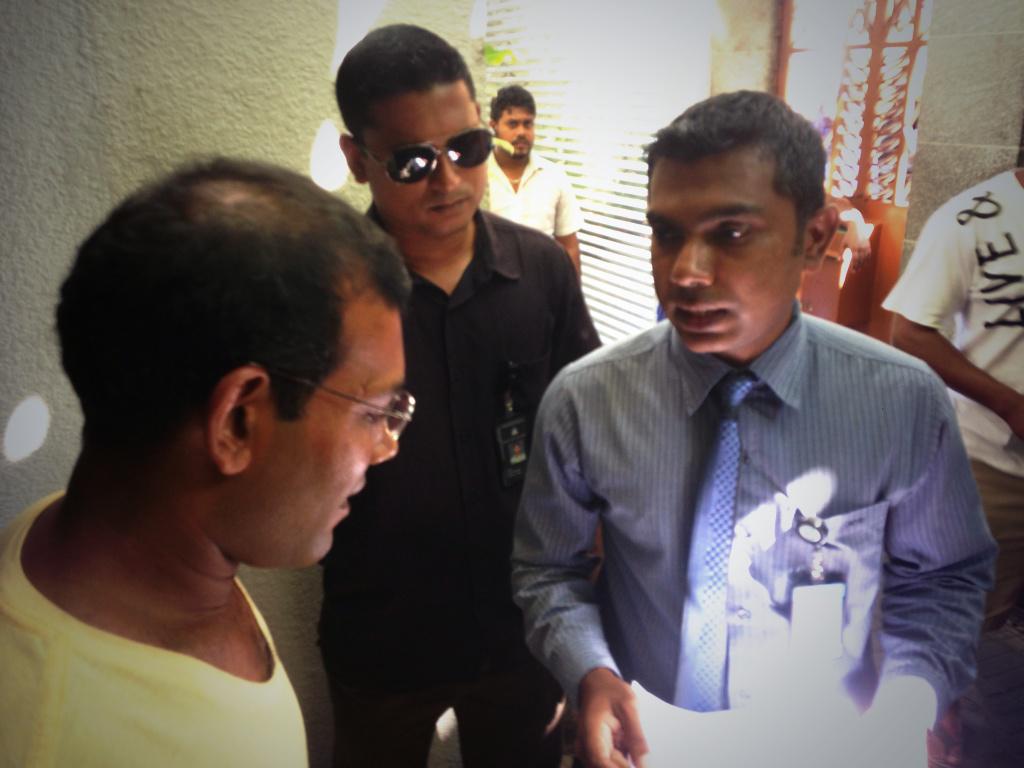
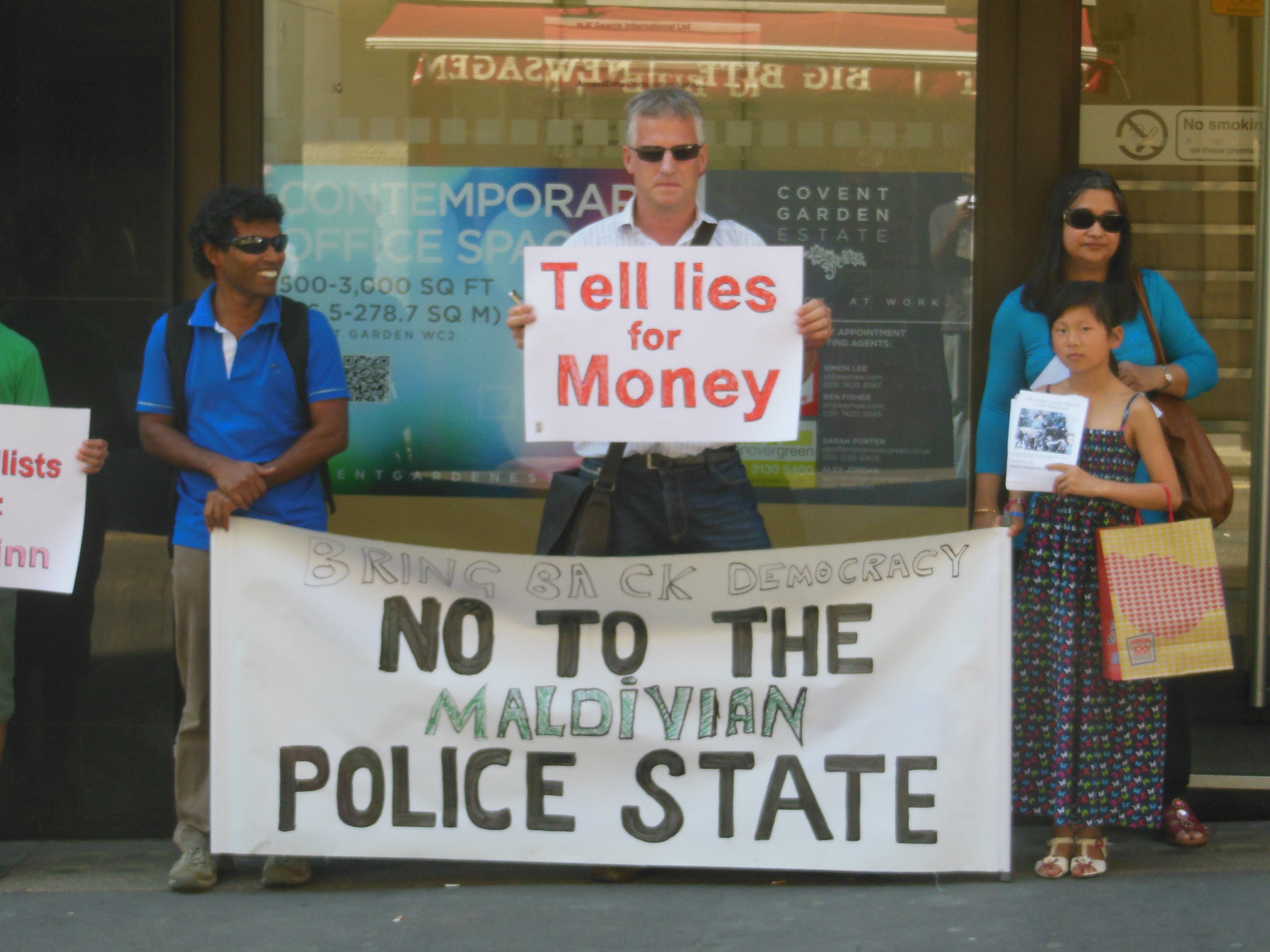
Friends of Maldives calls on the Foreign and Commonwealth Office to condemn the arrest today of former President Mohamed Nasheed of the Maldives and call on the country's Prosecutor General and the government of President Yaameen Abdul Gayoom to immediately release President Nasheed.
REF: http://www.bbc.co.uk/news/world-south-asia-31575279
The arrest of the country's first democratically elected leader on terror charges is a transparently political act intended to remove a respected democratic voice from the political process. The UN must call on the Maldives government to cease and desist from its long running campaign of intimidation against Nasheed and his supporters and condemn the brutality presently being inflicted by Police with pepper spray and tear gas on unarmed, peaceful demonstrators protesting the arrest.
FOM PRESS RELEASE 27.9.13
The Maldives crisis which began with the controversial change of government on 7 February 2012, is clearly linked to the judiciary - the forced resignation having come from the opposition following the 'removal' of 'Judge' Abdulla Mohamed from the Criminal Court.
Following the forced removal, the first democratically elected president, Mohamed Nasheed, was continuously persecuted over the months leading to the 7 September 2013 elections, and it brought to public attention a number of critical issues, major irregularities and deficiencies in the Judiciary as well as the system. It also highlighted the controversies of the Judicial Service Commission, which has been accused of deliberately and systematically corrupting the Judiciary. The book, Silent Coup.... gives a full account of events within JSC and outside which led to the successful hijack of the Judiciary in August 2010 by the then Opposition (former President Gayoom and his allies).
In the political fighting during transition, without a system of oversight or wide media and public awareness of constitutional matters, the international community pressured for political negotiation and a political deal was entered on the Supreme Court appointment where the then Majlis majority, DRP of former President Gayoom, approved their choice of men for the Supreme Court without check or due process.
The Judicial Service Commission which has the Duty to check and advice the President on names for Supreme Court did not exist as a legitimate institution at the time of Supreme Court appointment on 10 August 2010 as 4 seats on the 10 member Commission were vacant and there were no Office bearers.
JSC had earlier nullified Constitution Article 285 - concerning the appointment of judges under the new constitution according to new professional and ethical criteria - declaring it symbolic and refusing to honour the Constitutional obligation to screen every sitting judge and reappoint a new Judiciary.
Against this background, it is clear that the Supreme Court is highly politicised, and that the sitting 'Justices' have vested interests, and conflict of interest.
The politics of the Supreme Court has once again become evident in its intervention into matters of the election, and the manner in which the ongoing case is being conducted.
It is imperative for peace and stability in the Maldives, and the promotion of a Constitutional democratic State, that the Maldives hold the second round of elections on schedule and allow the People to elect their government.
The Supreme Court, already in ridicule by the Public for their political actions as well as the public exposé of the gross misconduct of Justice Ali Hameed, who continues to sit on the bench and judge the ongoing case on supposed election fraud without any substantial evidence, do not hold public trust.
Constitutionally a second round is mandated at a maximum of 21 days after the first, ie 28 September 2013.
The way forward for the Maldives is the immediate holding of the second round of free and fair elections held on 7 September 2013, and the building of a Constitutional democratic State through institution building.

The first democratically elected government of the Maldives fell on 7 February 2012 after only three years in power. President Mohamed Nasheed, central to the 2008 popular uprising that toppled the thirty-year long dictatorship (1978-2008) of Maumoon Abdul Gayoom, resigned live on national television. 'I sincerely believe that if this government is to remain in power, substantive force – which would harm many citizens – will become necessary,' he said. Within the hour, Nasheed's Vice President Dr Mohamed Waheed Hassan Manik was sworn in as the new president of the Maldives.
Compelling evidence has since emerged of a coup d'état, planned and executed by forces loyal to the thirty-year-long authoritarian regime of former dictator Maumoon Abdul Gayoom, deeply entrenched within the Maldivian political elite. Available video and audio footage suggests that key figures in the billion-dollar Maldivian tourism industry, and the increasingly influential Islamist movement, were heavily involved in the planning and execution of the coup. Together with a band of mutinying police and army officers, they held President Nasheed captive within the army HQ in Male' the capital until he agreed to 'resign without condition.'
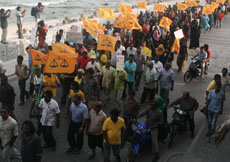
On 8 February, following President Nasheed's disclosure of details that forced his resignation, supporters of the Maldivian democracy took to the streets of Male' in protest. The police crackdown that followed was the most brutal the country has seen since transition to democracy. Several men and women were injured, and scores were arbitrarily arrested. The police specifically targeted key members of the Maldivian Democratic Party (MDP), including Nasheed himself.
Since then, police brutality, along with other practices that blatantly violate democratic values and principles, have become the norm. In the hands of the new regime, the law has become a political weapon for suppressing dissent. With the help of a corrupt judiciary, the State is claiming ownership of all available public spaces, criminalising protesters as trespassers. Freedom of expression, which had enjoyed exponential growth with transition to democracy, is being scaled back as government propaganda takes over independent journalism. The government has hired American PR giant Ruder Finn, at US$150,000 a month, to whitewash the coup, and the ongoing authoritarian reversal.
Having assumed power as a Vice President succeeding a President who resigns, Dr Waheed is required by law to continue with the MDP manifesto until the next elections. Yet, all MDP members have been fired from the cabinet and replaced with members of Gayoom's Progressive Party of Maldives and pro-authoritarian technocrats, or family relations of Dr Waheed. Although he maintains that the new government is 'a continuation' of Nasheed's, popular MDP policies, such as free universal healthcare and taxing the rich, have been amended to benefit the few. Tourism industry regulations aimed at sharing its wealth more equally are being overwritten to accommodate the tourism industry oligarchs complicit in the elected government's overthrow. Islamists are increasing their control of the Maldivian belief system, with agreements being signed with foreign governments actively promoting Islamism across the globe. By the end of this year, the budget deficit is expected to be 27 percent of the GDP, a 175 percent increase to earlier forecasts. IMF predicts economic collapse and has urged austerity measures, yet the government has increased spending in many areas. The police and military have been given pay raises along with promotions, perks and bonuses. The judiciary, which three years of democracy could not free from the shackles of authoritarian control, has become more blatantly biased and regularly makes a mockery of the rule of law.
Not only has the government turned a blind eye to the incessant demands for an investigation into the events of 7 February by Maldivian democrats, it has also turned a deaf ear to similar calls from the international community. Although the Indian government, followed closely by the United States, were quick to recognise Dr Waheed's government - to the deep disappointment of Maldivian democracy supporters - international organisations such as the Commonwealth and the European Union have been steadfast in their demand for an independent inquiry followed by early elections.
The Maldives is more than just a fabulous tourist destination. It is home to over 300,000 people, all of whom have the right to govern themselves. If you love the Maldives, and if you believe in democratic governance, support the Maldivians fighting for democracy. Without the support of the global community, the Maldivian fight would not be just more difficult to win; it will be nigh on impossible.
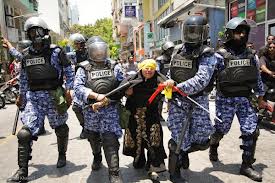
A sample of police brutality cases from Feb - Dec 2012
A parliamentary inquiry conducted by the Maldives Parliament's Oversight Committee has unearthed evidence of a systematic government cover-up. Due to its close involvement in the CoNI report, the Commonwealth Secretariat is implicated in the cover-up.
Friends of Maldives (FOM) believes that a complete travel boycott to the Maldives should be a matter of the last resort.